HCC Risk Adjustment Automation with NLP: A 2026 Guide
HCC risk adjustment, short for Hierarchical Condition Categories, is how CMS sets payments for Medicare Advantage plans and certain ACO and commercial risk-bearing contracts, based on the documented health complexity of a patient population. Unaddressed HCC codes are one of the largest sources of lost revenue in risk-bearing arrangements: chronic conditions are documented in prior notes but never recaptured in the current year.
This guide explains how HCC risk adjustment works in 2026 (under the V28 model), why manual coding leaves so much on the table, and what an NLP-based automation pipeline actually looks like in production on Azure and Microsoft Fabric.
What HCC risk adjustment is
CMS risk-adjusts payment for Medicare Advantage beneficiaries using the CMS-HCC model. Each beneficiary's HCC profile is recalibrated annually based on diagnoses documented during face-to-face encounters in the calendar year. Diagnoses from prior years do not roll over: if a patient had diabetes with complications documented in 2025 but no matching diagnosis is documented in 2026, that HCC is dropped from the risk score, even though the patient still has the condition.
In 2024–2026, CMS phased in HCC V28, the successor to V24. V28 restructures HCCs, drops some diagnosis codes, adds others, and changes the relative weights. For ACOs and MA plans, this shift has made accurate recapture of chronic conditions even more important.
Why manual coding leaves revenue on the table
Provider organizations typically run annual wellness visits (AWVs), chart prep workflows, and coder reviews to capture HCCs. The common failure modes:
- Short AWVs don't cover every active condition. A 30-minute AWV can't realistically re-address 10 chronic conditions.
- Notes reference conditions without coding them. A physician writes "patient has longstanding CHF" but doesn't put the condition on the problem list or code it in the billing flow.
- Suspecting logic is limited. Most EHRs show a "diagnoses previously coded" list but not a predictive list of "conditions your clinical notes suggest but which haven't been coded."
- Coder review happens retrospectively. By the time a certified coder reviews a chart post-visit, the encounter is closed and the patient is gone.
The combined effect is that 10–25% of eligible HCCs go uncaptured in a typical MA or ACO population, directly reducing the risk score and the associated payment.
What an NLP pipeline does differently
A well-designed HCC NLP pipeline surfaces pre-visit, per-patient, the list of likely HCC-relevant conditions documented in prior clinical notes but not yet coded in the current year. The clinician sees that list during the encounter, confirms or rules out each, and the confirmed HCCs become coded diagnoses in the visit's billing flow.
At a high level:
- Ingest clinical notes and structured data from the EHR via FHIR APIs (Epic, Cerner, Meditech).
- Extract condition mentions from unstructured text using clinical NLP (e.g., AWS Comprehend Medical, Azure Health Insights, or a fine-tuned LLM).
- Map extracted concepts to ICD-10 codes and then to HCC categories (V28).
- Filter conditions already coded in the current year and conditions that don't map to an HCC.
- Rank remaining conditions by HCC weight and confidence score.
- Deliver the resulting worklist to the clinician pre-visit, embedded in the EHR when possible (via SMART on FHIR, InBasket, or a side panel).
- Loop clinician confirmations back into training and monitoring.
Azure + Microsoft Fabric reference architecture
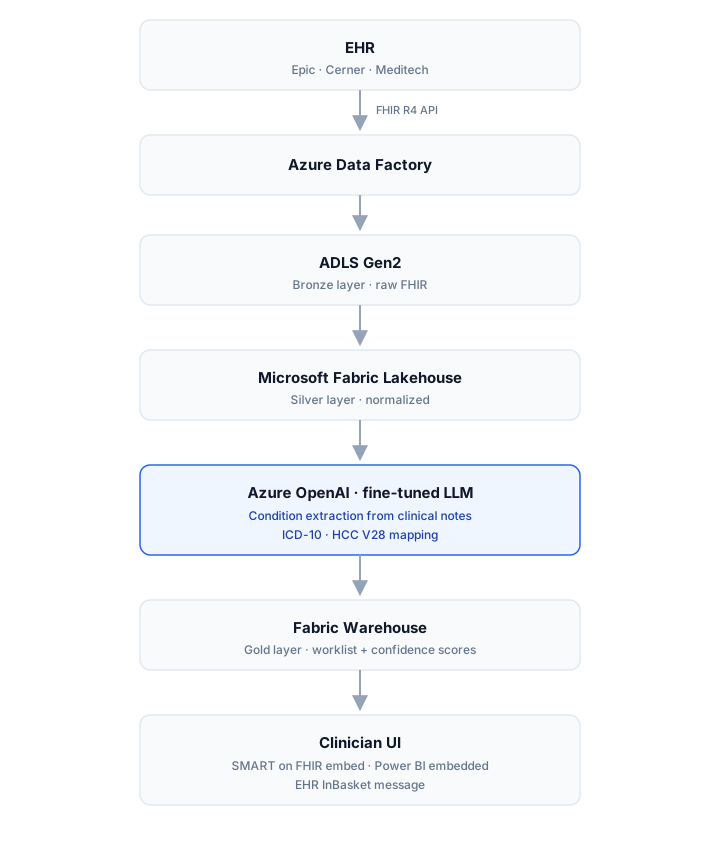
Key design decisions:
- FHIR-native ingestion.
DocumentReference,Condition,Observation,Encounterresources as the source of truth, not a flat clinical data export. - Separate the extraction model from the HCC mapping layer. Extraction should identify any condition; mapping decides which conditions are HCC-relevant under the current model (V28). Splitting these lets you switch extraction models without rebuilding HCC logic.
- Confidence thresholds. NLP outputs should include a confidence score. Below a threshold, the condition shouldn't be shown to clinicians, it creates alert fatigue and false-positive burden.
- Audit trail. Every suggestion shown to a clinician, every confirmation or rejection, should be logged for compliance and model improvement.
What you can measure
- HCC recapture rate. Percent of prior-year HCCs re-documented in the current year.
- Pre-visit list acceptance rate. Of suggestions shown, how many were confirmed, rejected, or ignored.
- Clinician time impact. Did the workflow save time, or add burden?
- Risk score impact. Year-over-year change in population risk score attributable to the pipeline.
Frequently asked questions
Is HCC NLP clinical decision support or a billing tool?
Both. The suggestions have clinical implications (confirming a condition triggers care planning) and financial implications (confirmed conditions flow to billing). Design the workflow so clinicians are comfortable with both framings.
Does this trigger CMS audit risk?
Poorly implemented NLP can. If the pipeline suggests unsupported diagnoses and clinicians confirm them without genuine documentation in the current encounter, that's a compliance risk. Good pipelines only suggest conditions the clinician validates and re-documents, not shortcuts to coding without a clinical basis.
Can we use a commercial HCC vendor instead of building?
Yes, there are commercial options. The build-vs-buy decision usually comes down to EHR integration depth, customization for V28, and whether the vendor's output format fits your clinical workflow. For organizations with complex multi-EHR footprints or custom clinical worklists, a purpose-built pipeline often wins.
What about the CMS-HCC V28 transition?
V28 is phased in through Medicare Advantage payment year 2026 (75% V28 + 25% V24 blended for PY2025, full V28 in subsequent years). ACOs in MSSP also use V28 with their own phase-in timing. Make sure your mapping layer targets V28 and not a deprecated V24 crosswalk.
How DATA4AI helps: We design and deploy HCC NLP pipelines on Azure and Microsoft Fabric, integrated with Epic and other major EHRs. Book a discovery call to talk through your HCC recapture rate, current workflow, and automation options.
Let's talk about your value-based care project.
Working on a value-based care contract, ACCESS Model application, EHR integration, or AI-enabled clinical workflow project? Book a 20-minute discovery call or email [email protected].